Business Waste Removal Newham — Health & Safety Policy
 This Health and Safety Policy sets out the commitment of Business Waste Removal Newham to maintain safe, compliant and reliable operations across our rubbish company service area. The policy applies to all staff, contractors and subcontractors engaged in commercial waste handling, collection and transfer activities. It describes how we minimise risk, protect employees and customers, and ensure our rubbish removal service area operates with due regard for health, safety and environmental considerations.
We recognise that the collection and transport of business waste introduces hazards that must be actively managed. Our approach emphasises risk assessment, safe systems of work, provision of appropriate personal protective equipment (PPE), and regular training. The policy is supported by documented procedures for vehicle loading and unloading, manual handling, waste segregation and identification of hazardous materials. Safety is a core part of service quality, and every team member is empowered to stop work if a significant risk is identified.
 The scope of the policy covers operations throughout our commercial rubbish service area, depot activities, customer premises work, and any third-party sites visited in the course of business. All operatives must follow site-specific instructions when attending customer locations and use the safety equipment provided. We maintain records of risk assessments, incident reports and corrective actions to ensure continuous improvement of health and safety performance.
To underpin safe activity across our waste removal service area we commit to the following core principles:
- Risk assessment and control: Regular identification and assessment of hazards with implementation of proportionate controls.
- Training and competency: Induction, refresher and role-specific training so personnel can operate safely in a rubbish collection service area.
- Safe equipment and maintenance: Routine inspection and servicing of vehicles, lifting gear and PPE to maintain safe working condition.
 Our operational safety standards include detailed procedures for vehicle safety checks, secure load restraint, reversing and exclusion zones, safe use of tail lifts and compaction systems, and measures to prevent slips, trips and falls when carrying out collections. Drivers and loaders must follow documented vehicle safety checklists before each shift and report defects immediately. Safe transport of commercial waste demands diligence at every stage, from bin handling to depot tipping.
Manual handling is a frequent exposure in a rubbish company service area and our policy requires task-specific assessments to reduce manual handling risks. We promote mechanical aids where practical, team lifting for heavy items and correct lifting techniques. New and temporary staff receive supervised practical training. Where lifting aids are not feasible, operations are planned to minimise repetitive strain and awkward postures.
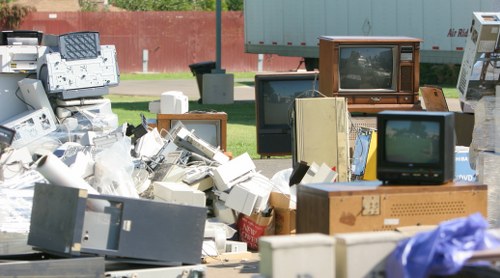
Waste segregation and hazardous materials control are critical. Operatives must identify and segregate hazardous waste such as sharps, chemical containers, asbestos suspects and electronic waste in accordance with safe handling procedures. Any suspected hazardous item is isolated, reported and, if necessary, left for specialist removal. Our teams are trained to recognise warning labels and to use spill kits and containment methods where required.
 Emergency preparedness and incident management are embedded in our arrangements. We maintain clear procedures for dealing with spills, vehicle incidents, medical emergencies and near-misses across the rubbish removal service area. All incidents are recorded, investigated and used as learning opportunities to prevent recurrence. First aid provision, emergency contacts and site evacuation instructions form part of employee induction and on-site briefings.
Supervision and accountability are essential. Line managers carry responsibility for ensuring safe systems are followed and for monitoring compliance during daily activities. Staff are expected to take reasonable care of their own health and safety, to co-operate with safety instructions, and to report hazards without delay. Every worker has the right and responsibility to stop work where they consider conditions to be unsafe.
 We also emphasise health considerations such as exposure to noise, dust and biohazards. Controls include provision of hearing protection, respiratory protective equipment when required and vaccination advice where relevant. Work schedules and rotation are used to reduce prolonged exposure to high-risk tasks. Occupational health support and access to counselling services are available to staff as part of our welfare provisions.
